Legislation
Did you know that if you find a stray dog you are required by law to report it to your local dog warden? Below are more details on what to do in this situation, as well as information on laws affecting pet owners, in particular The Clean Neighbourhoods & Environment Act 2005, The Control of Dogs Order 1992, The Animal Welfare Act 2007 and the Dangerous Dogs Act 1991.
Legal information if you have found a stray dog
If you find a stray dog it is a legal requirement to report the dog to your local authority animal warden. The Clean Neighbourhoods & Environment Act of 2005 stipulates that local authorities have 24-hour responsibility for stray dog control, so if you are unable to return the dog to its owner you need to contact your local authority.
Some local authorities operate a 24-hour service, others are only open during office hours. If you cannot keep the dog until your local authority point is open, please bring it to Battersea Dogs & Cats Home or take it to your local rescue centre. Do not release it back on to the streets.
A list of useful contact details can be found on our local boroughs page.
It's also advisable to contact veterinary surgeries and animal shelters in the area to let them know where you found the dog, what it looks like and its current whereabouts.
While there are no specific laws covering stray cats, if you find one it's advisable to contact veterinary surgeries and animal shelters in your local area to let them know where and when you found it, a physical description and its current whereabouts. It is also a good idea to put up posters and leaflets in public places advertising you have found a cat so the owner can contact you. You can download our free found poster.
In both cases we strongly advise you to contact the Battersea Lost Dogs & Cats Line on 0901 4778477 (calls cost 60p per minute from a BT landline, other networks may vary). The service, which operates within the M25, uses a database to match missing pets with owners and is open from 8am to 8pm.
General legal information for dog owners
Our duty to dogs
In 2007, The Animal Welfare Act replaced The Protection of Animals Act 1911. The original Act stated it is an offence to cruelly beat, kick, ill-treat, override, over-drive, overload, torture, infuriate, or terrify any animal wantonly, or unreasonably do or omit to do any act causing unnecessary suffering to any animal being the owner or having charge of any animal, without reasonable cause or excuse, abandon it, whether permanently or not, in circumstances likely to cause the animal any unnecessary suffering. The Animal Welfare Act introduces a welfare clause for the first time which places a 'duty of care' on pet owners to provide their animals with their basic needs, ie food, water, veterinary care and a suitable environment in which to live. The Act also raises the age from 12 to 16 for buying a pet, and makes it illegal to dock tails for cosmetic purposes.
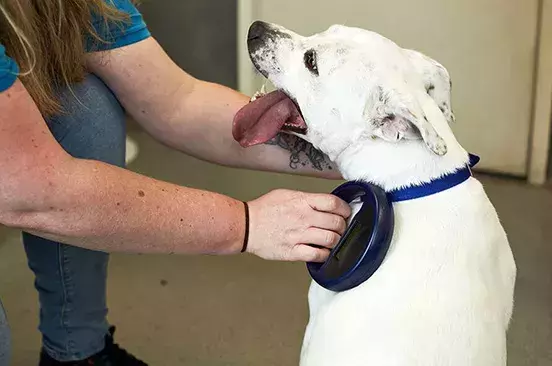
All dog owners, under the Control of Dogs Order 1992, are obliged to make sure their dog wears ID at all times in public. Legally this means a collar and tag giving the owner's name and address. This gives the advantage that if a lost dog gets found by a member of the public, they can meet their legal obligation by contacting the owner. Not only can they contact the owner, but it is their legal obligation to do so. Few people know that if you find a dog you must, by law, under the Environmental Protection Act 1990, either return it to its owner or take it to your local authority dog warden (see information above). It is also recommended by animal welfare organisations and many local authorities that pets are microchipped.
Dog owners' duty to the community
Firstly dog owners must protect the public from their dogs - who, by merit of having teeth and claws, can cause injury and damage if not properly controlled or managed. Under The Dangerous Dogs Act 1991, it is an offence to have a dog that is dangerously out of control in a public place, or a private place where it is not permitted to be, that gives a reasonable person grounds for apprehension. The law regarding dangerous dogs is both vast and complicated but suffice to say owners must do everything in their power to make sure their dog is not a danger to the public in any way. Owners also have a duty of care to protect anyone from their dog who visits their house lawfully.
Not only do we have to protect the public from injury, we also have to avoid inconveniencing them. Under the Environmental Protect Act 1990 it is an offence if your dog causes a nuisance to your neighbours - this refers to both smell and noise. Under this law having a barking dog that disturbs the neighbours means you can be fined up to £5,000, and then an additional 10% of the fine per day the offence continues.
Although we have significant duties when out with our dogs, it is not always a legal requirement to clean up after them. Individual district councils can make their own bylaws - these can ban dogs entirely from certain areas and outline areas where owners must clean up after their dog. Cleaning up after your dog is obviously the best and safest choice for dog owners in all public places, whether or not there is a legal obligation to do so.
There is currently a lot of discussion about where dogs must legally be kept on a lead. Again, local authorities can make their own bylaws regarding this as Dog Control Orders under provision of The Clean Neighbourhoods & Environment Act. The Animals Act 1971 imposes a duty upon owners to see their dog does not stray onto the road and cause injury or damage, so it is advisable to keep your dog on a lead on or near any road. As it is an offence under the Dogs (Protection of Livestock) Act 1953 for your dog to worry livestock or to be at large in a field or enclosure where there are sheep, there is an obligation for you to keep your dog on a lead (or else under control) if you are likely to encounter livestock. Under the Countryside Rights of Way Act 2000 landowners and local authorities can designate areas where dogs must be kept on a lead and are prohibited altogether.
This article was written by Carolyn Menteith with the assistance of Trevor Cooper for Paws magazine in spring 2003 and updated by Battersea Dogs & Cats Home in spring 2008.